Validation: Physics
Frasch (2026b). Minimum-Action Learning — Energy-Constrained Symbolic Model Selection for Physical Law Identification from Noisy Data. arXiv:2603.16951.
The claim
If NWAP is a genuine principle of efficient learning, then a learning system that explicitly extremises the network-weighted action should discover physical laws more efficiently than systems that minimise prediction error alone.
Method
A Triple-Action functional combining trajectory reconstruction, architectural sparsity, and energy-conservation enforcement is implemented as a training objective for symbolic regression. The functional is the discrete-time, finite-system analogue of $S_{\text{NW}}$.
Test problems are inverse problems with known ground truth — recovering Newton's law of gravitation from two-body trajectories, recovering Hooke's law from spring–mass oscillations — under varying noise levels.
The result
The Triple-Action objective recovers Kepler's gravitational-force law and Hooke's law from noisy observational data at order-of-magnitude reduced training energy compared with prediction-error-only baselines. Recovered symbolic forms are identical; the saving is in the search.
What this domain adds to the programme
It demonstrates that NWAP is operationally useful as a training-time objective — not only a post-hoc descriptive principle. A learning system explicitly extremising the network-weighted action discovers physics-grade laws faster than one that does not. This is the first non-physiology, non-biology test of the framework, and the first to produce engineering value.
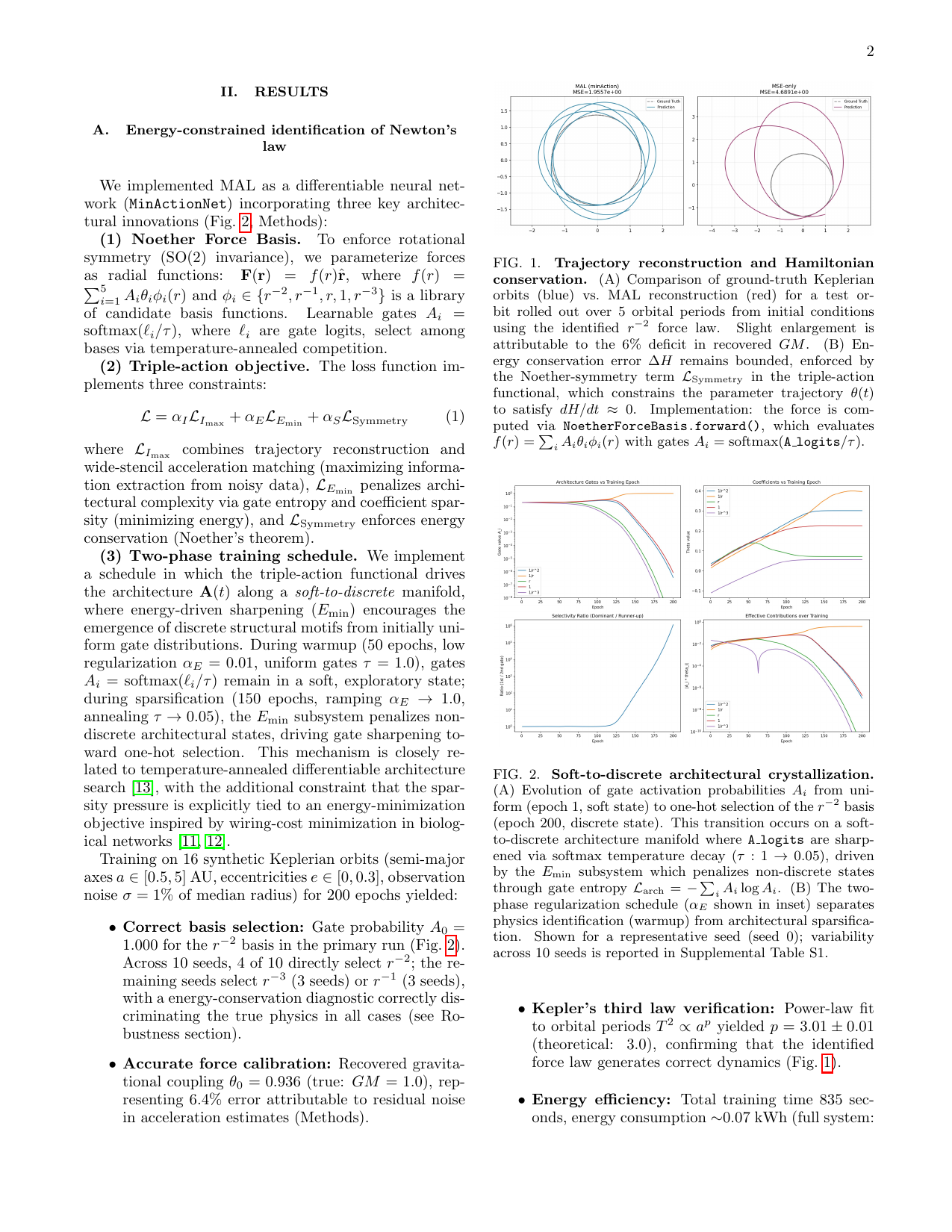
Headline figures from Frasch 2026b (arXiv:2603.16951). Top: trajectory reconstruction comparing the recovered force law to the ground-truth orbit. Bottom: soft-to-discrete architectural crystallisation under the Triple-Action functional — the gate distribution converges on a single basis (the true law) under temperature annealing.